.png)
BSCF Conference: Silicon Valley's Leading Startup Event
- earth_to_gillian

- Oct 3, 2019
- 5 min read
Updated: Oct 7, 2019

Last Sunday, I went to an entrepreneurship conference which was (fortunately) right on campus. It lasted from 12pm - 6pm. It was long, but with the fantastic lineup of entrepreneurs, it was one of the most productive 6 hours that I have had on a weekend. There are so many great insights that they talked about, but since it would be too long of a read, I decided to put the 10 insights that I thought were ones that could be applied not only professionally, but to your personal lives as well!
1. Pay less attention to the facts and more attention to the mechanisms
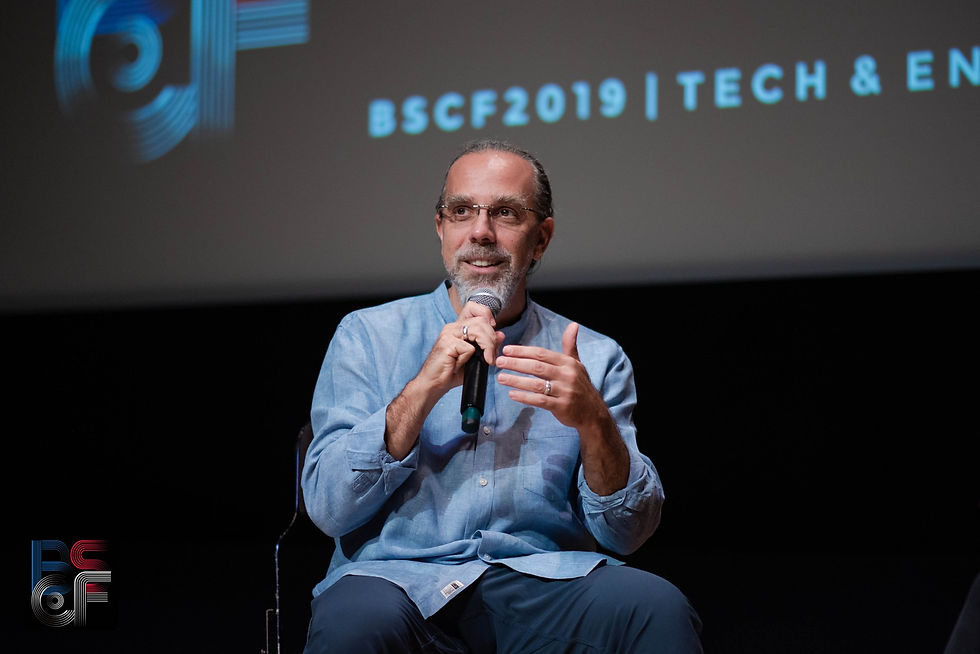
Astro Teller (the CEO of Google X) said a lot of great pieces of advice, and the next two below are from him too.
"I don't remember anything that I have learned in college." He said. "But if I could remember one thing, it would be the mechanisms. How did we arrive at that answer?"
The mechanisms, he said, are the ones that you could learn, ingrain and apply in real life once you get into the workplace.
2. High audacity, high humility
A.k.a have high self-confidence and low ego. To me, personally, I sometimes found these two go hand-in-hand. I tend to find myself having moments where I have very low self-confidence because I thought that could help keep my ego in check. But I realized that could be self-destructive and not at all productive.
So I definitely agree with what Astro said: that to have high audacity and high humility means that you can honestly and intellectually analyze what you did wrong and grow from that.
3. Pick your time horizon
Find what time you are optimizing. A lot of people tend to focus on short-term goals and consequences. One thing Astro said that struck me was when he said that people spent too much energy using too much time thinking about how to not get fired. Doing this means you have given up and are just being tied up to a traditional career.
"Do you really want to start life soulless?" Astro asked. "Why don't you just try to do the things that you're passionate about? If it works out, awesome. And if it doesn't, you have soulless as a backup!"
Ideally, that should be looking towards a long-term time frame, where you can have space for yourself to make mistakes, learn, and improve from that. You can be comfortable in admitting your own mistaking and admitting when you don't know, and at the same time, you're helping other people become comfortable in doing so as well.
"You can put your ego aside if your goal is to win 20-30 years later." Astro said.
By re-defining yourself and having a longer time horizon, you can realize and admit the things that you have done wrong and make better decisions in the future.
4. Honesty is the best policy

A lot of the entrepreneurs in the conference lineup mentioned something about honesty. This included Astro Teller, Sallie Krawcheck (CEO of Ellevest), and Matt Jacobson (Head of Market Development at Facebook).
I thought Sallie had very interesting insights on honesty in the workplace. She talked about her first two rises to fame at Wall Street. The first time she rose to fame was when she was named the "Last Honest Analyst" by Fortune.
The second time she rose to fame was when she was the CFO of Citigroup and lobbied the board of directors to return client funds. But as a result, she got fired.
"I knew I would be fired." She said. "But I thought that doing the right thing was more important than money."
She was able to reimburse clients, and because of this, was then later named "The Only WSJ Executive that Returned Client Funds".
6. Develop Your Investing Skills
Another piece of advice by Sallie was to learn to invest. She started her company, Ellevest, to encourage women to learn how to invest, as they do so less than men. Why? Because, generally, they take failure harder than men. They are more scared of losing money and risk-averse.
However, Sallie strongly advocates investing. When you invest with compound interest, your money over time grows. And this concept of investment and growth is something that does not only apply to money, but to your relationships and to your career.
The best tool you could have for growth is time. So equip yourself with skills on how to invest in all areas of your life, and it could bring some surprising rewards your way.
7. Be curious
Curiosity ties in directly with growth. It trains you to ask questions and gather new information which can help you learn and grow. Astro mentioned that at Google X, they look for people by how they ask questions, not how they give answers. It shows that you demonstrate a passion for learning and your ability to build upon each other's ideas.
Be willing to try new things, indulge in new challenges, and take risks even if you could face embarrassment. Matt Jacobson also supports this and suggests that having a mentor is another helpful way to learn new things. Find someone you would like to be mentored by and just ask! That's all part of the curious process. At the same time, the more you know, the more you will realize which area you would like to specialize at and further hone your skills.
Always, always ask questions. As they say, there's no such thing as a dumb question.
8. Be AI-fluent

This is more on the professional side, but I do think that this could be applied to any job nowadays. Dinkar Jain (Head of Machine Learning of Facebook Ads) had a fascinating talk on how AI is now a core function in this digital era. It has become such a huge role in our everyday lives and platforms, including Facebook, Instagram, Netflix, YouTube, and other social media. It is now the main tool in building brands and increasing customer engagement through better identifying their needs.
You don't have to be a Computer Science major to be AI-fluent. Being AI-fluent does not mean you have to know how to code or program machine learning algorithms. All you have to do is understand it. Understand how the algorithm works, what does it do and how does it add customer value. At the same time, have a broad understanding of your target market, and with those insights, you can then find ways to integrate it into the AI model to make it more accurate in catering customers.
9. Be the best part of someone else's day

Matt Jacobson is the 8th employee of Facebook. He has been working under Mark Zuckerberg ever since, and is now the Head of Market Development. The reason why he stayed was because of the vision that Mark had, and also of the core values that Facebook upheld and how it remained consistent throughout the years: being bold, making impact, moving fast, and social good.
But you have to understand the context around the core values, otherwise, it would not make sense, and people could make wrong decisions.
So how did he help his team better understand the core values and make them successful?
"When I ran teams, my daily meditation for myself was being the best part of someone else's day." Matt said. He also made his team's KPI based on being "the best part of your cross-functional worker's day".
To Matt, hiring the right people who truly understood these values, and who knew how to treat people respectfully was what made a successful team.
"When I first worked in Hollywood, I had some rough bosses. It was a rough business. The fact that they [the younger generation] can choose their leaders and know how to be treated, I think it's a really positive thing."
By choosing people that you can follow, you will be able to have better personal guidelines for yourself and a clearer vision. At the same time, you can work with them well since your values align.



Comments